When to Apply to Georgetown
Before applying to Georgetown, you should decide whether you want to apply in the early or regular round — the application timeline differs for each.
Georgetown Deadlines
It’s important to be aware of the deadlines that are applicable to your chosen round to ensure you submit all your application materials on time. The deadlines for the 2026-27 application cycle are:
- Early Action: November 1, 2026
- Regular Decision: January 1, 2027
- Financial aid materials: February 1, 2027
Students who apply in the early round can expect a decision on December 15. For Regular Decision applicants, the decision date is April 1. For either round, students have until May 1 to decide if they want to enroll.
Early, Rolling, and Regular Decision
Georgetown offers two application options: Early Action and Regular Decision.
Early Action is an early application type that is non-binding. This means you can apply to multiple places Early Action (if they are not Restrictive Early Action or Single Choice Early Action). This application type gives you the chance to show your interest in the school early and receive your admission results early. It is a good option for students with strong grades throughout high school who feel their profile is competitive without their first semester senior grades.
Another early option is Early Decision, which is like Early Action except it is binding — students applying Early Decision must enroll if admitted and withdraw all other applications. Georgetown does not offer Early Decision, but many other top schools do.
Regular Decision is a standard, non-binding application type. This is generally the most popular option, and it gives you more time to prepare your application since the deadline is later.
Finally, rolling admission is when applications are accepted and reviewed without a single deadline but on an ongoing, rolling basis. Georgetown does not offer rolling admission.
Waitlisted Applications
If you apply to Georgetown University Regular Decision, there are three possible decision notifications you may receive: accepted, denied, or waitlisted. The waitlist is made up of strong students the university does not have the space to admit. You can accept or decline your spot, though your chances of getting off the waitlist are slim. Out of the 2,672 students waitlisted at Georgetown for fall 2025, only 356 were admitted.
Deferrals
If you apply to Georgetown via Early Action, you will either be admitted or deferred. When you’re deferred, it means your application will be evaluated with the Regular Decision pool.
So, what should you do if you’ve been deferred? Georgetown highly encourages deferred students to maintain excellent grades and submit additions to their applications, like new standardized test scores, honors, and awards. It is also standard to send a letter of continued interest reiterating your commitment to the university.
How Hard Is It to Get into Georgetown: Early Prep
Admission to Georgetown is quite competitive. It is considered a reach school by any standard, as recent admissions rates show:
That said, selectivity goes beyond the numbers. How hard it is to get into a college depends on many different factors, including institutional priorities, diversity initiatives, and more. The most important thing you can do as an individual applicant is work on making your application as strong as possible. The first way to think about doing that is by strategically building your profile.
Build Your Profile
College admission isn’t all about who you are and where you come from, of course. Mainly, your profile is about what you have done — the classes you’ve taken in high school; how you have performed in them; and other activities, initiatives, and leadership positions that have shaped you. That said, what does Georgetown University look for? Georgetown seeks to admit a class of diverse students who are extremely motivated and talented.
Because colleges look at all four years of high school, it’s important to start building your profile early. Commit to extracurricular activities and give yourself room to grow, from newcomer to president of a club. Identify your interests and dive in, participating in programs and initiatives that will highlight your passions. And maintain high grades in the most rigorous courses available.
Visit the Campus
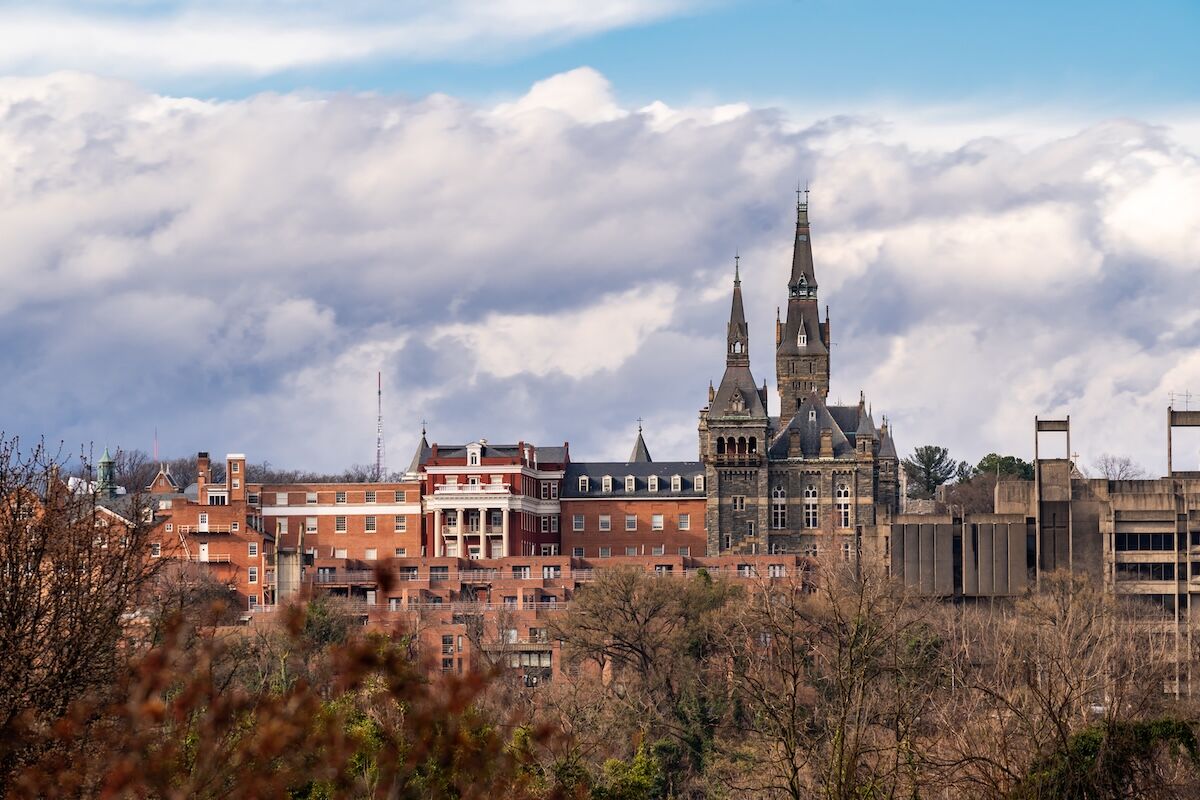
If you can find the time and resources, there’s nothing like visiting Georgetown in person. An on-campus visit includes a campus tour and information session. With its towering gothic buildings overlooking the river, the campus is a stunning setting to get a stellar education. Leave time before or after your official campus visit to walk around Georgetown itself. It’s one of Washington, D.C.’s most charming neighborhoods, lined with brick and cobblestone and glittering with great shopping destinations.
Can’t make it to campus? Georgetown offers virtual information sessions with an admissions officer as well as virtual reality walking tours.
Connect with a Student
Georgetown provides opportunities for prospective students to learn about campus life through virtual student panels — a Q&A session with current students. Another option is to sign up for a virtual Coffee and Chat with a current Georgetown student or connect with students who are part of the Georgetown Admissions Ambassador Program.
Learn About Any Student Experiences
While the admissions office offers plenty of opportunities for you to learn about student experiences, you can take some additional steps on your own. Following current students on social media and reading Georgetown’s student-run newspaper, “The Hoya” can give you additional perspectives on campus life.
How Do You Actually Get into Georgetown: The Application
Students applying to Georgetown have the option of using the Georgetown application, which opens on June 1, or the Common Application, which opens on August 1.
For your application to stand out, it’s important to understand the profile of admitted students so you can see how you compare. It’s also worth noting that Georgetown does not track demonstrated interest.
GPA Requirements
Georgetown does not report the GPAs of their enrolled students in their Common Data Set. However, they do report class rank. Of the students from the class of 2029 who reported their class rank, 87% graduated in the top 10%. Given Georgetown’s high degree of selectivity, you can assume that you will need to earn top grades in the most rigorous courses available to you.
SAT and ACT Scores
Georgetown requires standardized test scores for admission. For the class of 2029, the middle 50% of students scored 1405-1530 on the SAT and 32-35 on the ACT. If you want to be a Hoya, aim to get test scores within these ranges. Your scores must be submitted no later than January of your senior year.
Essays
Georgetown requires applicants to respond to two short essay prompts and two long essay prompts. These are Georgetown specific — the Common App Personal Statement is not required.
Short Essay 1: Briefly discuss the significance to you of the school or summer activity in which you have been most involved. (250 Words)
Short Essay 2: In all our lives, we interact with people who hold different viewpoints than our own. Describe such an event you experienced. What did you learn from the experience? (250 Words)
Essay 1: As Georgetown is a diverse community, the Admissions Committee would like to know more about you in your own words. Please submit a brief personal or creative essay which you feel best describes you and reflects on your personal background and individual experiences, skills, and talents. (650 Words)
- If you believe that your Common App personal statement would fit with this prompt, you are welcome to use it here.
Essay 2: School Specific Essay Prompt (500 Words)
- For Applicants to the College of Arts & Sciences: Founded in 1789, the Georgetown College of Arts & Sciences is committed to the Jesuit traditions of an integrated education and of productive research in the natural sciences, humanities, social sciences, and fine arts. Describe your interest in studying in the College of Arts & Sciences. Applicants interested in the sciences, mathematics, or languages are encouraged to make specific reference to their choice of major.
- For Applicants to the McCourt School of Public Policy: For nearly 50 years, Georgetown University’s McCourt School of Public Policy has equipped leaders and changemakers with the interdisciplinary skills to address local, national and global policy problems. Undergraduate public policy students at Georgetown will have the unique opportunity to live and study on two campuses, spending their first two years immersed on the Hilltop, before completing the second half of their time at Georgetown on the Capitol Campus, immersed in the policy world. Describe your primary motivations for studying public policy at Georgetown University and dedicating your undergraduate studies toward a future related to public service.
- Applicants to the Earth Commons Institute: Through this joint program between the College of Arts & Sciences and the Earth Commons Institute, you’ll explore theories and practical skills in the classroom, in the field, and around the world, and put it all together to make a difference. Describe your primary motivations for studying environment and sustainability at Georgetown University to effect positive change in the world.
- For Applicants to the Berkley School of Nursing: Georgetown University’s Berkley School of Nursing is committed to the formation of ethical, empathetic, and transformational nursing leaders. Describe the factors that have influenced your interest in studying Nursing at Georgetown University.
- Applicants to the School of Health: Georgetown University’s School of Health was founded to advance the health and well-being of people locally, nationally, and globally through innovative research, the delivery of interdisciplinary education, and transformative engagement of communities. Describe the factors that influenced your interest in studying health care at Georgetown University, specifically addressing your intended related major: Global Health, Health Care Management & Policy, or Human Science.
- For Applicants to the Walsh School of Foreign Service: Georgetown University’s Walsh School of Foreign Service was founded more than a century ago to prepare generations of leaders with the foundational skills to address global issues. Describe your primary motivations for studying international affairs at Georgetown University and dedicating your undergraduate studies toward a future in global service.
- For Applicants to the McDonough School of Business: Georgetown University’s McDonough School of Business provides graduates with essential global, ethical, analytical, financial, and diverse perspectives on the economies of our nation and the world. Describe your primary motivations for studying business at Georgetown University.
Letters of Recommendation
Georgetown requires two recommendation letters: one from a teacher and one from your school counselor. You are also allowed to submit a second recommendation from a teacher, but this is optional. Be intentional about the teacher you choose to write a letter of recommendation — ideally, it should be a teacher from a core academic subject who taught you during junior or senior year. It’s especially helpful if they taught a subject that’s relevant to your academic interest, such as math or social studies for McDonough School of Business applicants.
Admission Interviews
Georgetown requires admissions interviews as an important extra step in the admissions process. Students must set up an interview with an Alumni Admissions Program Committee member once they receive the interviewer’s contact information. Interviews are arranged according to your geographic area.
The Georgetown alumni interview is a chance for students to highlight certain aspects of their backgrounds and achievements. It’s also a great opportunity to ask an alumnus about their experience at Georgetown.
Contribution to the Georgetown Community
If you’re interested in attending Georgetown, it’s important to articulate through your essays and interview what impact you plan to make at the university. Be specific. Name clubs, courses, research opportunities, professors, and other aspects of Georgetown that are of particular interest to you.
Class Profile
As you research Georgetown University, it can be helpful to review the class profile. This provides information about how many people apply to Georgetown, the acceptance rate, class size and demographics, geographic distribution of students, and more. This information can help you better understand Georgetown’s admission standards so you can assess your chances of being accepted.
Here are some quick statistics for the class of 2029:
What Makes Georgetown Unique?
Georgetown is unique in so many ways! It’s a gorgeous, neo-Gothic campus in one of Washington D.C.’s most beautiful neighborhoods. It offers excellent undergraduate and graduate degrees in five different major colleges.
The Walsh School of Foreign Service offers more specialized undergraduate majors in this field than most universities, including majors in culture and politics; global business; international economics; international history; international political economy; international politics; regional and comparative studies; and science, technology & international affairs. Georgetown also offers many other programs of study in its four other academic colleges, the College of Arts and Sciences, the McDonough School of Business, the School of Health, and the School of Nursing.
Its location in Washington, D.C., makes it an incredible place to live and study for many reasons. Students have access to the city’s cultural offerings, such as museums, historical sites, monuments, sports, and theater, and access to national resources like the Library of Congress — not to mention, numerous internship opportunities.
Georgetown may be right for you if you are passionate about making the world a better place, feel strongly about cultural and linguistic diversity, and want to take advantage of the offerings of our nation’s capital.
Georgetown FAQs
Where is Georgetown University?
Georgetown University is in the Georgetown neighborhood in Washington, D.C.
How many students does Georgetown accept?
While the acceptance rate fluctuates from year to year, it is currently around 13%, making it a highly competitive school.
What are Georgetown’s best majors?
Georgetown is particularly known for its international relations and government programs, but business-related majors are also popular.
What GPA do you need to get into Georgetown?
While Georgetown does not specify a minimum GPA for admission, most undergraduate students graduated in the top 10% of their high school class.
What does Georgetown look for in students?
Georgetown looks for students who are highly accomplished and talented both academically and in their extracurricular pursuits. Students are expected to make an impact in the campus community.
Admission Counseling
After reading and better understanding what it takes to gain admission to Georgetown University, it’s easy to understand why families may be interested in hiring an admissions counselor who can help students develop a strategic plan, build their profiles, and more. The highly selective world of U.S. college admissions is one that takes time and work. While students can manage this process on their own, hiring an admissions consultant can streamline the process, replacing some of the anxiety and confusion with guidance and reassurance.
Getting into Georgetown is challenging, but IvyWise counselors are here to give you the best possible chance of getting into your dream school. Set up an Initial Consultation to get in touch with a counselor.
Get Started