Key Takeaways
- UGA vs. GT is one of college athletics’ most iconic rivalries, spanning more than a century.
- The schools contrast in academics, campus culture, and admissions priorities.
- UGA offers a traditional college town experience rooted in liberal arts and school spirit, while Georgia Tech is known for rigorous STEM academics, an urban campus, and strong industry connections.
- The rivalry influences student life, alumni engagement, and communities across Georgia.
- Admission to both schools is competitive, with Georgia Tech being the more selective of the two.
The Historic Rivalry of UGA vs. GT
The University of Georgia and Georgia Tech have a famous rivalry — known as “Clean, Old-Fashioned Hate” — that was established before their first football game in 1893. While they are known for their college football rivalry, their matchups on the baseball diamond are where it took root. The rivalry escalated once Georgia Tech established a football team. Since then, antagonization on both sides has further fueled the conflict.
Here are some key moments in UGA vs GT football history:
- 1893:The inaugural football game led to the harassment of GT players, triggering the creation of their “Ramblin’ Wreck” fight song.
- 1919-1924:Athletic ties were broken due to parade floats mocking GT for continuing football games during World War I — UGA had suspended their program. This set the stage for decades of intense, sometimes bitter, interactions.
- 2024: The longest game in the rivalry occurred, with Georgia beating Georgia Tech in the eighth overtime.
The UGA vs GT sports rivalry is not only central to each institution’s culture and identity, but it is also significant to their local communities and to the state.
Academic Showdown: UGA vs. GT
Despite their intense rivalry in sports, UGA collaborates on Georgia Tech research projects and vice versa, focusing on healthcare initiatives. As public universities, they serve the needs of the state — combining their strengths allows them to find solutions that improve the quality of life for Georgia residents.
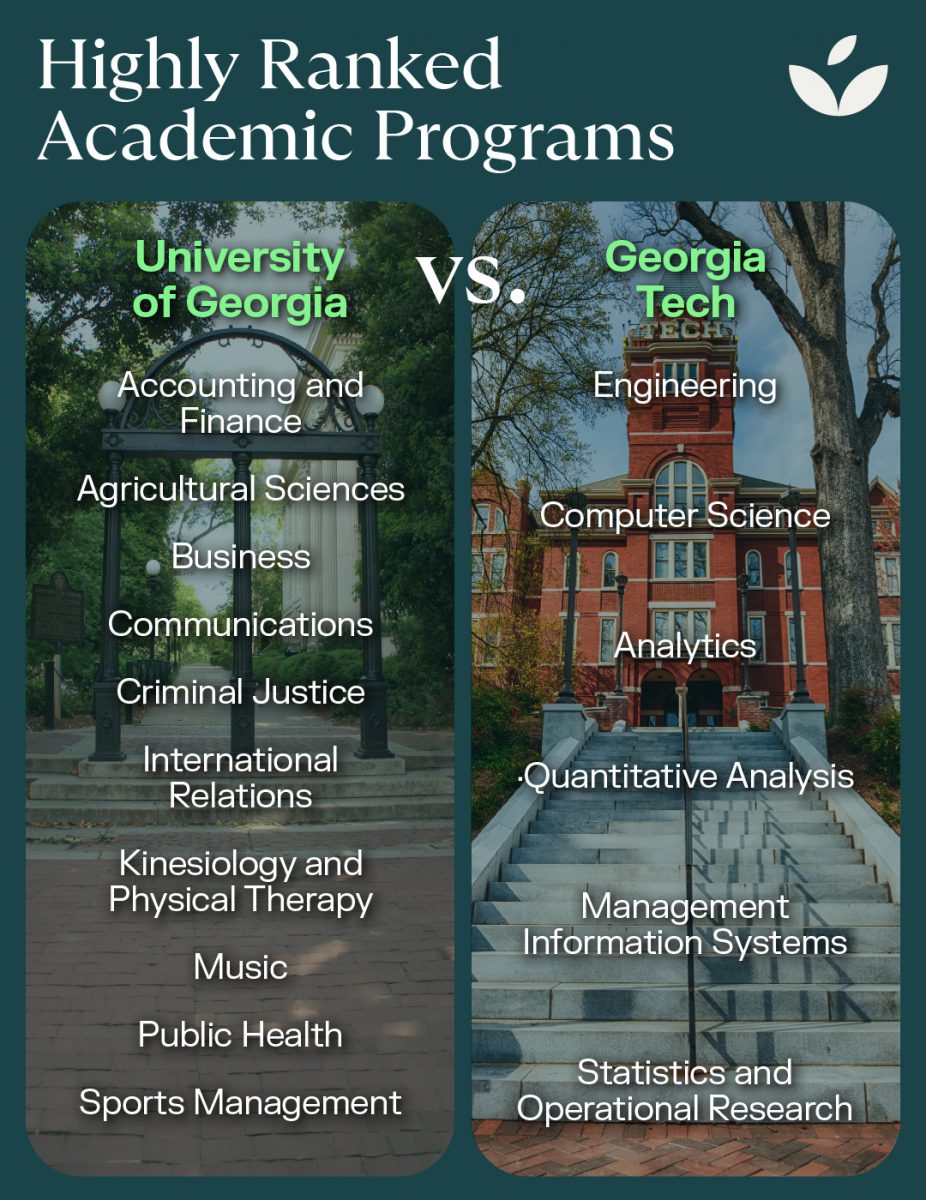
In terms of a UGA vs GT academic comparison, both have stellar academic reputations but are strong in different areas. The University of Georgia offers an education grounded in the liberal arts, while Georgia Tech’s curriculum is STEM focused. This infographic shows which programs are highly ranked at each school.
UGA vs Georgia Tech Engineering
If you plan to study engineering, both UGA and GT offer great programs. However, there are some differences in how the programs are presented.
Georgia Tech engineering is consistently ranked as one of the top programs in the nation. Students can choose from a range of disciplines, including biomedical engineering, chemical and biomolecular engineering, industrial and systems engineering, materials science and engineering, and aerospace engineering, among others. The curriculum is highly focused on STEM, and academics are rigorous and fast-paced. Undergraduates are encouraged to take advantage of co-op, research, and internship opportunities to build their resumes.
At the University of Georgia, students also have a variety of engineering disciplines from which to choose, such as agricultural engineering, biochemical engineering, computer systems engineering, biological engineering, and more. Because UGA is more liberal arts focused, students enjoy a more interdisciplinary curriculum. Engineering students have opportunities to participate in research, internships, study away programs, and co-ops.
Academic Initiatives and Research
At Georgia Tech, undergraduate research is integrated into the academic experience. Through the Undergraduate Research Opportunities Program, students can engage in high-level research regardless of major. A hallmark of the Tech experience is the Vertically Integrated Projects program, which allows undergraduates to join large-scale, multi-disciplinary research teams led by faculty, where they can remain for several semesters to gain deep technical expertise and leadership skills. Additionally, initiatives like the President’s Undergraduate Research Awards provide competitive funding for student salaries and travel to national conferences, ensuring that innovation — from AI and cybersecurity to sustainable design — is accessible to students as early as their freshman year.
The Center for Undergraduate Research Opportunities at UGA is open to all students from their first year, regardless of major or Honors status. Through the CURO Research Award, the university provides 500 scholarships of $1,000 each annually to support faculty-mentored projects across all disciplines. In the spring, students can present their findings to the public during the CURO Symposium. For those seeking deeper immersion, the CURO Summer Research Fellowship offers a $3,000 stipend for intensive 320-hour projects.
Athletic Rivalries: More Than Just Football
The UGA vs. GT football rivalry has been intense since their first game in 1893. Tech came out ahead, and — as the story goes — UGA fans chased them to the train station with rocks and knives. Other factors in the rivalry include the 70-mile proximity of their campuses and the cultural differences between the schools. Both teams compete for dominance, recruiting, and bragging rights.
But football isn’t the only sport with an intense rivalry. The basketball and baseball teams are also very competitive. Additionally, both UGA and GT have elite golf and tennis programs, making their rivalry in those sports surprisingly heated.
Impact on Student Life and Alumni Engagement
The college sports rivalry is an important part of student life at both campuses. In fact, certain school traditions are based on their hate for each other.
At Georgia Tech:
- Both fight songs reference GT’s disdain for UGA.
- Students avoid wearing anything red, since it’s UGA’s primary color.
- GT’s famous Model A Ford mascot, known as “The Ramblin’ Reck,” often mocks UGA during homecoming.
At UGA:
- The Chapel Bell, which normally rings until midnight after wins, is rung all night after a win against GT.
- Georgia adds a reference to GT in their fight song, “Glory, Glory” when they are playing the Yellow Jackets.
- Georgia fans have nicknamed GT the North Avenue Trade School, Georgia Tech University, or GTU and refer to GT fans as gnats, dorks, nerds, and Techies.
The rivalry also helps with alumni engagement, which spikes during the week of the game. It’s a major driver for donations and provides a lifelong connection point for graduates who moved away from the state.
Campus Life: Athens vs. Atlanta
One is located in a major city, the other in a quintessential college town. While both are top-tier public institutions, they offer completely different vibes. Each campus is shaped by its academic focus, geography, and social and cultural influences.
Student Experience
If you’re considering both UGA and GT for your college list, it can be helpful to understand what the student experience is like at each campus. When it comes to Athens vs Atlanta, consider how location, social life, and sports culture will impact your college experience.
Cultural and Social Opportunities
UGA and GT students enjoy a wealth of cultural and social opportunities beyond campus. Both institutions are inextricably linked to their surrounding communities, enhancing the student experience.
If you like music history, Athens is the place to be. It’s the birthplace of bands like R.E.M. and the B-52s, and students get to experience iconic music venues like the Georgia Theatre and the 40 Watt Club. It’s also a great place for art, with the Georgia Museum of Art, the Athens Institute for Contemporary Art, and the Lyndon House Arts Center all located near campus. Students can enjoy the eclectic shops and restaurants downtown as well as outdoor recreation and community events.
Georgia Tech is in the heart of “Silicon Peach” — the moniker given to Atlanta’s tech and startup culture. And with numerous Fortune 500 companies based in Atlanta, GT students have access to a wealth of internship and networking opportunities. Atlanta’s status as a global city also means that students have access to world-class museums, diverse food scenes, and major cultural events and festivals throughout the year.
Impact on Local Communities
The rivalry between UGA and Georgia Tech provides a variety of social and economic benefits for their respective communities. In fact, Rivalry Week is the most important weekend for local businesses in both Midtown Atlanta and Athens — as fans arrive for the game, they are providing an economic boost to the hotels, restaurants, and shops in the area. The communities also benefit from charitable fundraisers and blood drives that take place during Rivalry Week.
Admissions Showdown: Navigating UGA and GT
When it comes to the admissions process at GT and UGA, their evaluation styles and priorities vary significantly. This table shows the key differences in their respective admissions processes.
It’s important to note that both institutions require standardized test scores as part of their admissions process, and neither track demonstrated interest.
Admissions Statistics and Competitiveness
Both schools have become significantly more selective over the last few years, making admissions highly competitive. Let’s look at the trends in admissions statistics over the past four years.
Acceptance Rates: Class of 2027 Through 2030
As you can see, the acceptance rates have decreased each year. So, how can prospective students stand out in their applications to maximize their chances of admission?
How Applications Are Evaluated
Like most selective institutions, GT and UGA employ a holistic review process. They look for students who have demonstrated that they can handle the rigors of college-level work. Your transcript should show that you have taken the most challenging courses available at your high school and mastered them, especially in your areas of interest. Additionally, your ACT or SAT scores should be within or above the score range of the middle 50% percent of students who enrolled.
- University of Georgia: The middle 50% score range for UGA’s class of 2029 was 1300-1470 on the SAT and 30-34 on the ACT.
- Georgia Tech: The middle 50% score range for GT’s class of 2029 was 1370-1530 on the SAT and 31-35 on the ACT.
While your academic record is the first factor considered, it’s the other factors of your application that will help you stand out from your peers. Admissions committees want to see sustained involvement in meaningful extracurriculars, leadership skills, and how you made an impact at school and in your community. Your Common App personal statement, supplemental essay, and recommendation letters complete your application. Together, all these factors must tell a cohesive and authentic story about you — what drives you, how you think, and what you will contribute to the campus community.
Scholarships and Financial Aid: UGA vs. GT
When it comes to financial aid and scholarships, UGA and GT only differ when it comes to institutional aid. Both use the FAFSA to determine how much and what types of federal financial aid to award. Additionally, eligible students may apply for Georgia higher education scholarships, such as the HOPE and Zell Miller Scholarships, at either school to cover a significant portion of tuition.
As for institutional aid, UGA and GT offer a large variety of scholarship programs that help cover college costs, as shown in this table. Georgia Tech applicants fill out the Georgia Tech Application for Scholarships and Financial Aid (GT App) in addition to the FAFSA to be considered for institutional scholarships. Students may also be eligible for college or departmental scholarships at both institutions.
Students should take care when filling out both the FAFSA and GT App (if applicable) that the required information is accurate, complete, and submitted on time.
Choosing Between UGA and GT
Ultimately, the most important way to decide between UGA and GT is to assess how each school aligns with your academic and career goals, finances, and social needs. Choosing your best-fit college ensures that you’ll thrive. It’s also worth considering the rivalry and how it defines the alumni network and social identity you will be a part of — this could potentially impact career opportunities down the road, whether you want to work at a tech company as a Yellow Jacket or practice law as a Dawg.
Regardless of where you choose to apply, the current admissions landscape is highly competitive. Working with an independent college admissions counselor can help you submit a compelling application that stands out. At IvyWise, all our counselors have admissions experience at some of the top schools in the world, so they know what admissions committees look for and how to position you for the greatest chance of success.
Contact Us