When to Apply to Cornell
It’s important to start early so that you can prepare the strongest application possible. Cornell’s application period opens on August 1, just before most prospective students begin their senior year of high school. However, students hoping to be admitted to Cornell should begin the application process well before that, compiling as much relevant information as possible ahead of time and working on their essay drafts.
Cornell Deadlines
Cornell’s individual application deadlines correspond to the typical Early Decision and Regular Decision timeline. Cornell’s application deadlines for the 2026-27 admissions cycle are:
Early Decision
- November 1, 2026: Application due; financial aid materials due for international students
- November 13, 2026: All other required materials due
- November 15, 2026: Priority aid application due for domestic students
Regular Decision
- January 2, 2027: Application due; portfolio or design supplement due (if applicable); financial aid materials due for international students
- January 19, 2027: All other required materials due
- February 15, 2027: Priority aid application due for domestic students
These deadlines may vary slightly in future years. Always check the university’s website for the most up-to-date information on deadlines. Cornell releases decisions in mid-December for Early Decision applicants and late March for Regular Decision.
Early, Rolling, and Regular Decision
Most colleges and universities offer different application types, such as Regular Decision, Early Decision, and Early Action, though these options will vary by institution. Early Decision is a binding application option — if you are admitted Early Decision, you must enroll at that school and withdraw all other applications. Early Action is a non-binding early application that does not require you to enroll if you are admitted. Regular Decision is a non-binding option that comes later than Early Decision and Early Action and is typically more competitive.
Cornell University does not offer Early Action, however. Cornell’s admission options are Early Decision and Regular Decision. Cornell University only offers Early Decision but not Early Decision II, which is a later option for students to apply for binding admission. Applying Early Decision may increase a student’s chances of admission since they are committing to attending if accepted.
Rolling admission is another option available at some colleges and universities that is non-binding and does not adhere to strict deadlines. Cornell does not offer rolling admission.
Waitlisted Applications
When applying to Cornell, you must choose which individual school or college you want to attend. According to the Cornell admissions office, certain schools or colleges offer their applicants spots on the waitlist, whereas others do not. Students who are waitlisted can choose to accept or deny their spot on the waitlist, though it is important to keep in mind that the chance for admission is low. The Cornell waitlist acceptance rate for the Class of 2029 was 3.85%.
Deferrals
A student applying Early Decision to Cornell University will receive one of three possible admission decisions: accepted, denied, or deferred. When a student is deferred, that means the admissions committee is waiting until the Regular Decision round to decide if the student will be admitted. This is often because additional information is needed, like the student’s grades from the first semester of their senior year.
It helps to know what to do if you have been deferred. Typically, you send the university additional information — such as first semester senior year grades and a letter of continued interest — that may add to your application. Students who are deferred should always check with the admissions office to see what additional information they need and be sure to follow all directions: Not every school will accept letters of continued interest.
How Hard Is It to Get into Cornell: Early Prep
So, you’re probably wondering how hard it is to get into Cornell. As an Ivy League University, Cornell is consistently one of the most competitive and highly selective universities in the country, with an admission rate below 10%. So you know what to expect, here are Cornell’s admission rates in recent years:
Preparing to apply to Cornell University requires making yourself the best applicant you can be in the classroom, your activities, and your community. This means getting an early start on building your profile — Cornell, like all colleges and universities, will evaluate your academic performance and activities starting from ninth grade.
Build Your Profile
What does Cornell look for in an applicant? Cornell is looking for bright, curious, and motivated students who will help build the vibrant and diverse campus community.
To be a competitive applicant to Cornell, prospective students should start building their profile as early as possible. Your profile includes everything about you as an applicant: your academic background and history, your extracurricular involvement, and the contributions you have made to your school and community.
Schools like Cornell look for “pointy” students who demonstrate deep engagement and growth in their field(s) of interest through their high school course selection and extracurricular activities. Students who get an early start on building their profile have more time to become pointy by building on their interest(s).
Students applying to Cornell should consider which Cornell school or college best aligns with their academic profile. Cornell’s nine schools and colleges are:
- College of Agriculture and Life Sciences
- College of Architecture, Art, and Planning
- College of Arts and Sciences
- Cornell SC Johnson College of Business
- Cornell Ann S. Bowers College of Computing and Information Science
- College of Engineering
- College of Human Ecology
- School of Industrial and Labor Relations
- Cornell Jeb E. Brooks School of Public Policy
Cornell University looks for multitalented and involved students who have made significant contributions to their high schools and communities. Applicants should highlight their involvement in their applications and thread connections to how their interests make them a good fit for Cornell.
Visit the Campus and a Class
Visiting campus is one of the best ways to thoroughly get to know the vibe of the place and visualize how you would fit in. Cornell offers prospective students the opportunity to take a self-guided tour of campus via a smartphone app. The Welcome Center staff is available to answer questions and provide information.
Prospective students can also register for a student-led campus tour and/or an admissions information session. Spaces are limited for the student-led tours, so it’s best to register as early as possible. Both options present good opportunities to speak to students and staff about campus life, which can give you an even more complete picture of Cornell. For students who are not able to visit campus in person, Cornell also offers a virtual tour and on-demand admissions information session videos.
Interested in observing a class at Cornell? Check with the school or college you’re interested in to see if opportunities are available. For example, the Cornell Peter and Stephanie Nolan School of Hotel Administration within the College of Business allows prospective students to sit in on a class.
Connect with a Student
Another great way to learn more about a university is by connecting with a current student. If you register for a student-led tour, you can chat with your tour guide before or after the tour, so don’t be shy! Individual schools and colleges may offer additional opportunities to connect with students. The College of Arts and Sciences, for example, has an ambassador program that connects prospective students with current students in the college.
Learn About Any Student Experiences
To learn more about student experiences, follow current students on social media. Reading student publications, such as “The Cornell Daily Sun,” can also give you some great insights into campus life.
How Do You Actually Get into Cornell: The Application
Cornell is looking for the best and brightest to join its ranks. To be considered for admission, you must apply and meet all application requirements including submitting the Common Application, the writing supplement for your chosen college or school, your high school transcript, a counselor letter of recommendation, teacher evaluations, a school report, and optional standardized test scores. You may need to submit a portfolio and/or additional materials depending on the program to which you’re applying.
GPA Requirements
Cornell does not report the GPAs of admitted students. However, Cornell’s Common Data Set for the class of 2029 shows that of the applicants who reported their high school class rank, 84% graduated in the top 10% of their class. Because of Cornell’s status as an Ivy League and its high selectivity, applicants need a strong GPA to be competitive for admission.
SAT and ACT Scores
Test scores are required at Cornell. To understand what a good test score is for admission, it helps to look at the Common Data Set. While Cornell was still test-optional for fall 2025 admission, it reported the score range for the middle 50% of students who submitted test scores and were admitted: 1490-1550 on the SAT and 33-35 on the ACT.
Personal Statement
The Common Application personal statement is one of the most important qualitative factors of the application process. The seven Common App essay prompts range from specific to very open-ended, allowing students to write about virtually anything. The personal statement is an opportunity for applicants to introduce themselves to the admissions committee beyond the numbers and other hard factors in their application.
Essays
In addition to the personal statement, students will respond one or more Cornell supplemental essay prompts depending on the college or school to which they’re applying. The Cornell essay prompt that all applicants were required to respond to was eliminated for the 2026-27 admissions cycle.
Letters of Recommendation
Letters of recommendation provide the opportunity for admissions officers to learn more about the student from the perspective of counselors and teachers. Cornell requires one letter from the student’s school counselor, college counselor, headmaster, or principal, as well as two teacher recommendations that speak to the applicant’s academic strengths and contributions.
Admission Interviews
Admission interviews are not required for students applying for undergraduate admission. However, applicants may schedule an informational meeting with a volunteer from the Cornell Alumni Admissions Ambassador Network (CAAAN) who resides in their local area. This is optional and does not have an impact on your admission status. Applicants may request this meeting in the Common App during the application process or on the Cornell application status page after their application is submitted; however, these meetings are not guaranteed.
Contribution to the Cornell Community
Cornell students make valuable contributions to the school community through their wide variety of interests and expertise. As a Cornell University applicant, you must showcase your academic and extracurricular interests in your application.
Ultimately, the office of undergraduate admissions seeks to put together a well-rounded class of student specialists who have demonstrated a deep knowledge in their areas of interest. They consider each applicant’s soft factors in several ways, including how those factors will contribute to the campus community. However, Cornell does not track demonstrated interest.
Class Profile
So, how many people apply to Cornell? The University received 65,514 applications for fall 2026 and ultimately admitted 6,040.
What Makes Cornell Unique?
So, what makes Cornell University unique? Among other things, Cornell is a private land-grant university, meaning that the state of New York provides Cornell with financial support. Its status as a land-grant institution means that Cornell University, despite being a private school, contributes its research and innovation in a way that benefits the state. Cornell is the only Ivy League university that is also a land-grant university.
Additionally, Cornell is world renowned for its commitment to climate change research and sustainability. It’s also the only elite school in the U.S. to offer a four-year program in hotel administration — in fact, it’s one of the top hospitality schools in the country.
Cornell has built a rich set of traditions that give the campus its distinct character throughout the year. Every spring, first-year architecture students construct and parade a massive dragon across campus for Dragon Day, a tradition dating back to 1901 that culminates in a playful rivalry with the engineering school. The Cornell Chimes, played on 21 bells housed in historic McGraw Tower, ring out three times daily, performed by student chimesmasters who earn the role through a competitive audition.
Athletics carry their own rituals, from the Big Red Bear, an unofficial mascot who’s represented the university since 1915, to the Sy Katz ’31 Parade — featuring the Big Red Marching Band — that takes place in New York City when the Big Red football team takes on Columbia. And when the academic year winds down, students gather on Libe Slope for Slope Day, an end-of-semester concert and celebration that marks the unofficial start of finals season.
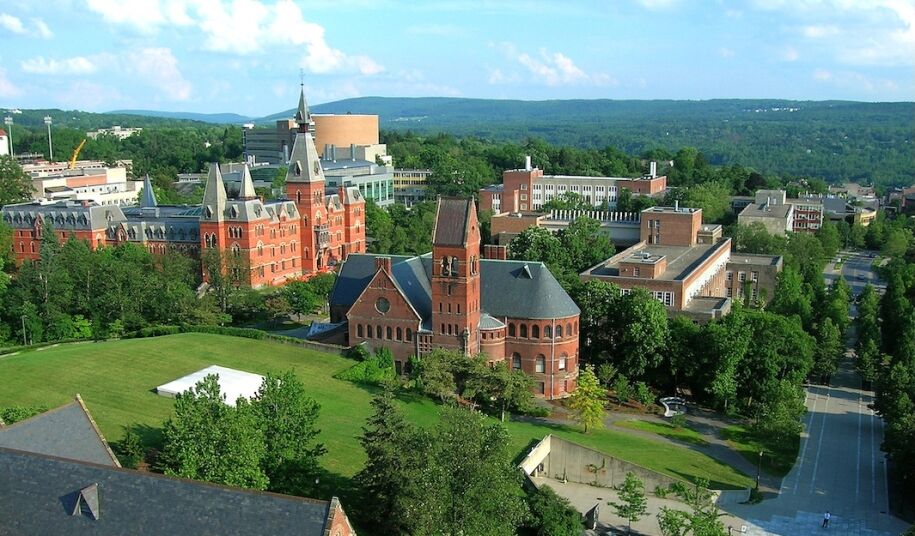
Cornell may be the right fit for applicants looking for a rigorous Ivy League education in a beautiful, small city setting. Students enjoy all that Cornell has to offer along with the spectacular natural wonders of New York’s Finger Lakes region.
Cornell FAQs
Where is Cornell University located?
Cornell is located in Ithaca, New York.
What is the acceptance rate at Cornell?
The admission rate at Cornell was 8.38% for fall 2025.
Does Cornell require ACT or SAT scores?
Standardized test scores are required for admission.
What are the application deadlines for undergraduate programs?
Cornell offers Early Decision with a deadline of November 1 and Regular Decision with a deadline of January 2.
What is Cornell looking for in applicants?
Cornell emphasizes intellectual potential, strength of character, love of learning, ability, achievements, motivation, leadership, diligence, and integrity. They review transcripts, test scores, essays, recommendations, and extracurricular activities.
Admissions Counseling
Students seeking admission to highly selective schools may find it beneficial to work with a private admissions counselor. Experienced counselors understand the entire college admissions process and can guide students through each step. At the same time, they can demystify the process for students and families and keep them on track as they work toward their college admissions goals.
It’s important to look for a college admissions counselor who has experience working in admissions committees. Since they were a part of the decision-making process, they have firsthand knowledge of what admissions committees look for when evaluating applications. At IvyWise, our college admissions counselors are all former Deans and Directors of admission at some of the top schools in the U.S. and internationally. They have read thousands of college applications and know what it takes for students to stand out. Get started today by scheduling an Initial Consultation.
Contact Us