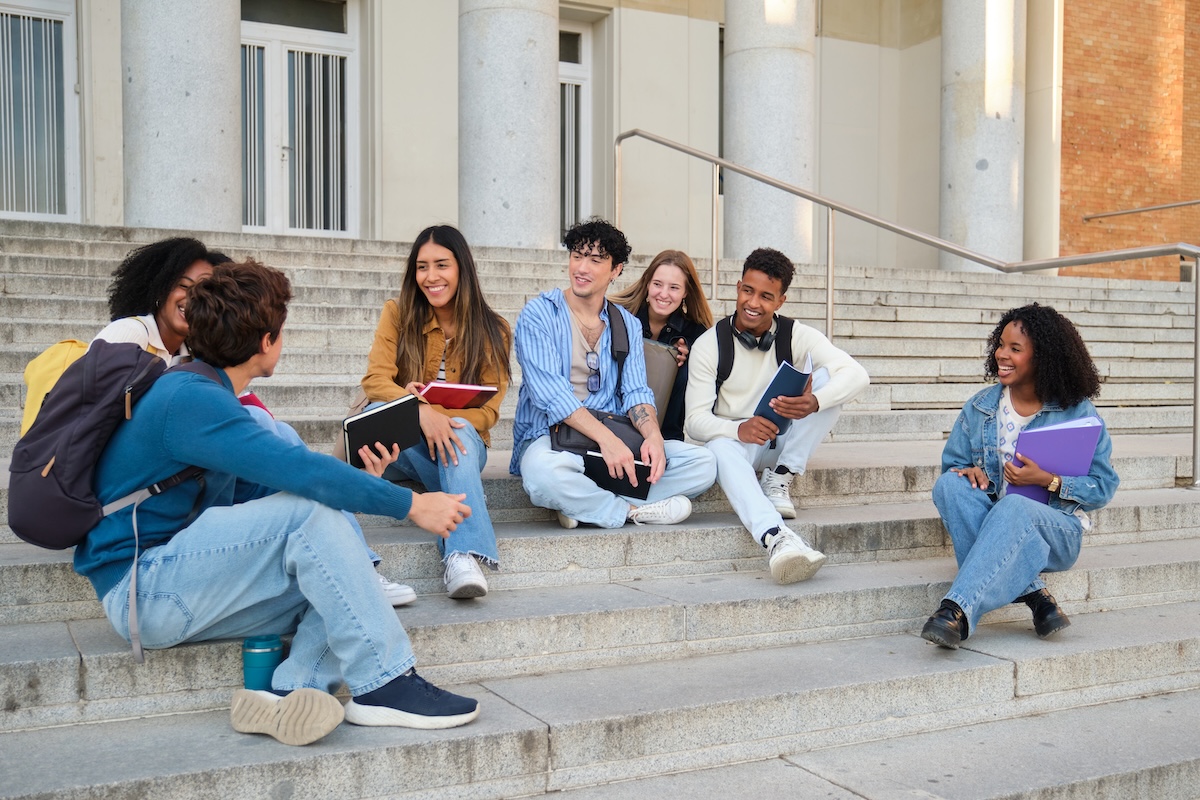
Transitioning from high school to college is about far more than just moving into a dorm — it is a fundamental shift in how you learn, socialize, and grow. In this semester 12 finale episode of IvyWise’s Just Admit It! podcast, host Tasha and IvyWise counselor Amy break down the hidden realities of the university experience.
Key Takeaways
- While you will likely juggle fewer individual classes per semester than in high school, the burden of tracking graduation requirements and selecting the right courses falls entirely on you.
- It’s critical to understand that you belong in the room — utilize office hours and introduce yourself to professors early on.
- Unlike the open-door policy of most high school clubs, many college organizations are highly selective and student-run. Prepare yourself for potential cuts or auditions, but embrace the freedom to launch your own club if your niche doesn’t exist.
- College grants you massive amounts of free time. Establishing a daily routine, setting strict personal boundaries, and getting an on-campus job are the best ways to stay grounded and avoid the trap of procrastination.
- You do not need to obsess over your post-grad career on day one, but your freshman year should include a visit to the career services office. Give yourself a healthy four-year runway by stacking campus jobs, internships, and research opportunities.
Podcast Transcript
Tasha:
Hi there. Welcome to semester 12, episode 10 of the IvyWise Just Admit It! podcast, where former deans and directors of admission give expert insight into the complex college admissions landscape. This is the final episode of this season. I’m Tasha, your host. I’m an admissions counselor at IvyWise, a former international admissions officer at USC, and former assistant director of international admissions at Boston University.
And this season is FAQs in college admissions. We spent the season focusing on a different frequently asked question, breaking it down, and answering it thoroughly. On today’s final episode of the season: How is college different from high school? This is a big question, but I think one we can definitely tackle. To help me answer this question is my colleague, Amy. Hi, Amy.
Amy:
Hi, Tasha.
Tasha:
How are you?
Amy:
Feeling great.
Tasha:
Great. Thank you so much for joining us on this episode of Just Admit It! Could you please introduce yourself to our listeners?
Amy:
Sure, happy to. My name is Amy Kirkcaldy, and I’m a former admission and financial aid officer at Harvard College. After that, I went on to become a college counselor at an independent school just south of Boston. And I come from a family of educators and consider myself a lifelong educator, so I’ve worked at both public and private high schools as well as public and private universities.
So, I’ll do my best today to offer a variety of perspectives on how college is different than high school.
Tasha:
Great. It sounds like you’re the perfect guest for this episode, as I knew you would be. So, let’s get started. It’s a really broad question, so we’re going to break it down into three broad themes or categories: academic, personal, and social.
Let’s start with academics, which I would say is the meat and potatoes of what high school and college are. You’re there for academic learning. So, let’s start with teachers. Throughout K–12, we call instructors “teachers,” but in college, they’re often called “professors.” What’s the difference there, not only in their training, but more specifically as they relate to their students and how students should be interacting with them and taking advantage of their knowledge?
Amy:
While this seems like a simple question, the reality is that it completely depends on your background and where you are headed. I attended a public high school in Massachusetts and built great relationships with my teachers. However, when I went to Harvard as an undergrad, my experience with professors was entirely different. They all held Ph.D.s and were major names in their fields. I found them deeply interesting, but also quite intimidating.
I didn’t form close relationships with my professors, and a part of that stems from the fact that my public school education hadn’t equipped me to feel empowered to visit them during office hours. I really wish I had received that piece of advice at the time.
Later in my career, I noticed that the students I worked with at an independent school felt completely natural seeking out high-profile faculty. That’s why I think it’s so important to coach public school students who might not be getting this message: You absolutely deserve to meet with these prominent professors. Introduce yourself, get to know them as people, and remember that they are entirely accessible once you make the effort to approach them.
Tasha:
Great, Amy. And then I think the next obvious academic question is related to classes, right? So how do you choose your classes, or when do you have class in high school versus college?
Amy:
When it comes to choosing your college classes, you will typically meet with an academic advisor, though the level of guidance varies greatly by campus. You might get paired with an advisor who perfectly understands your graduation pathway, or you might end up with someone who means well but is a bit less schooled in what you actually need to take. Ultimately, the burden of course selection falls more heavily on the student. You are the one responsible for tracking requirements and ensuring you graduate on time.
Despite that weight, the academic freedom is incredibly exciting. College is far less restrictive than high school, where you generally have to take four years of everything. Instead, you shape your schedule around your intended major, minors, certificate programs, and unique electives. That flexibility does demand long-term strategy, though.
I studied abroad my junior year, which meant I had to very carefully map out my classes from my very first semester to make a full year away happen. There are a lot of factors to weigh, but the flexibility is well worth it.
Tasha:
Yeah, and then I’ll also add that scheduling is a really big difference. In high school, you’re at school all day, whereas in college, you might have a really varied schedule.
I remember one time, my senior fall, I only had class two or three times a week, but I had class most of the day. The other days, it didn’t mean I was on vacation, right? It meant I really had to schedule my time thoughtfully and be self-sufficient in how I spent that time to do outside class work and homework for those classes. We’ll talk a little bit more about that when we get to personal and social life, which is that time management piece.
But I think that definitely comes into play when you think about classes. When do you have class, how often do you have class, for how many hours do you have class? Let’s talk about how many classes you take, which kind of helps get into that piece.
Amy:
I think the course load really depends on the institution, Tasha. Looking back at my own experience, I believe I typically took four or five classes a semester. This number can certainly vary across different colleges and depending on your specific path, but one rule remains universal: It is definitely fewer individual classes than you are used to juggling in high school.
Tasha:
A student’s full-time schedule is primarily based on a set number of credits required each semester, though that specific threshold looks a little different at every school. Because individual classes carry varying credit weights — unless a university uses a standardized course unit system — the total number of credits is what ultimately dictates how many classes you take.
Beyond the credits themselves, your actual time in the classroom is highly dependent on the school and the nature of the course. A student’s week will look completely different depending on whether they are enrolled in a large lecture class, a small seminar, or a laboratory section. Amy, do you have any thoughts to add on that?
Amy:
The daily routine looks entirely different depending on your major, particularly for those in STEM fields versus the humanities. As a humanities major, my classes typically met for an hour on Mondays, Wednesdays, and Fridays, or for an hour and a half on Tuesdays and Thursdays. STEM students will inherently spend a lot more time in labs, making their schedules much more variable.
Another hallmark of the college schedule is how classes are structured. While full-fledged professors taught most of my main lectures, those large classes would regularly break down into smaller discussion sections led by graduate students. This setup added an extra hour to our weekly schedule, but it gave us a great space to dive deeper into the material and ask targeted questions. Ultimately, no matter what you choose to study, you will spend fewer cumulative hours in a classroom compared to a standard high school day.
Tasha:
I would also add that in addition to STEM, I think language courses tend to be much more frequent as well, especially in the intro classes. I think the logic is that frequency will help with the learning and fluency more quickly. Especially Mandarin, Arabic — languages that have totally different alphabets — will meet four to five times a week often in the intro-level classes.
Then let’s talk about rigor, because I think that really comes into play when talking about academic differences between high school and college. How does rigor differ —or does it necessarily differ — for students?
Amy:
While academic rigor varies across institutions, a college’s reputation does not necessarily dictate how challenging it will be. What matters far more is a student’s individual high school preparation. If you come from a background where you have already mastered time management, effective study habits, and self-awareness as a learner, college will not feel nearly as daunting. Even under rigorous academic standards, your preparation ensures you know exactly how to handle the workload.
In my experience, the undergraduates who had the hardest time navigating university academics were actually those who cruised through high school without trying. Because they never had to exert themselves, they arrived at college lacking the necessary executive functioning, time management, and organizational habits. Academic difficulty is subjective; it depends heavily on your preparedness and your attitude toward self-management.
Tasha:
Yeah, that actually makes a lot of sense. I think rigor can be very subjective. Some things are harder for some students than for others, depending on strengths. There are certainly some universities that are much more rigorous than others, and some high schools that are much more rigorous than others.
So, it depends on the leap that’s being taken. But I think overall, the level of rigor in college does tend to be higher than in high school. Whether you experience that as necessarily more challenging, though, might depend on your level of preparation, Amy, it sounds like. Is that right?
Amy:
In over a decade at an independent school, I only had one student come back and say college was harder — and they were a pre-med student at UChicago. That was truly the only time. To me, that speaks volumes about how well our school was preparing students.
It’s not that they found it easy, but it wasn’t a huge step up for them. For me, coming from a public school, it also wasn’t that big of a transition academically because I had prepared so rigorously on my own with time management. But the content and the fact that I was suddenly surrounded by so many people who challenged me — that was the real adjustment. I wasn’t used to that environment in public school, so college felt more rigorous in that sense. The people around me were pushing me a lot harder than I was used to.
Tasha:
Wow. Yeah, that’s great to hear about your students, that they were so well prepared. Any other differences on academics before we move on to our next category?
Amy:
I think just the freedom. It’s so nice to go to college and be able to take some really interesting and sometimes wacky classes. I had one that was on archeology in Mexico. I had another one that was about “I Love Lucy” and popular culture in the 1950s. I’m a big “I Love Lucy” fan, and I ended up writing an entire research paper about her. It was just so liberating to be able to take things that I never even dreamed were possible when I was at a public high school with such a standardized curriculum.
Tasha:
Yeah, that’s so true. I will always remember an art history seminar I took during my senior year called Bad Art. It explored the concepts of taste, kitsch, and camp, asking what makes art good or bad, and who actually gets to decide.
It was so much fun. I wrote a major research paper on an artist I really disliked, which gave me the chance to interrogate why I hated his work when so many others loved him — he was incredibly popular where I grew up in Florida. It really highlights the freedom you get in college to explore highly specific topics that you wouldn’t necessarily get to dive into in high school, though some independent schools do have a bit more flexibility there.
But, great. Thank you, Amy. That’s another big difference for sure: academic freedom.
All right, personal is our next category of how high school and college are different. What are some main differences? For the purposes of this episode, I want to say that we are going to focus on a traditional residential college experience. We recognize that this could absolutely be different for students staying at home and commuting or going to community college, but we’re looking at the highly selective, usually residential college experience for this.
Amy:
I think the biggest personal difference boils down to two things. The first is probably just learning to manage yourself as an adult. It might state the obvious, but this is a huge lesson you learn in college. Being off on your own means managing your own schedule, tracking your work, and figuring out self-care — like knowing how to handle it when you’re sick or feeling anxious.
That self-discipline is especially tough in an age where we’re constantly connected. Students today are much more connected to their parents because it’s so easy to just pick up the phone. In a way, you have to actively fight for your own independence and find the strength to pull yourself away so you can develop those necessary life skills.
The second thing is simply how powerful the residential experience is. By far, my most valuable learning experience in college came from the people I lived and studied with, even more than what I was learning in the classroom, even though the academics were wonderful too. Being surrounded by true diversity — living, eating, and studying with people while seeing them at their best and their worst — is just an incredibly rewarding and enriching experience.
Tasha:
Time management has already come up in this conversation, and it’s going to keep coming up because it’s such a major difference. It’s part of that adulthood piece. So, let’s talk about how students should manage their time in college or how they should think about different ways to manage their time.
Amy:
The college transition is tough because everyone is different, but establishing a solid routine is universal. Start by setting a consistent wake-up time every day, even if you don’t have an early class, and intentionally carve out time for fun and wellness. If you’re a runner, physically put that into your schedule. Most people actually find that the busier they are, the easier it is to stay productive. Unstructured free time can be dangerous for productivity, and adjusting to that massive amount of open time is often the hardest part of college.
One great way to manage this is to add meaningful structure, like a campus job. Even if a student doesn’t need the income, a job offers valuable pre-professional experience, introduces you to new people, and builds a productive framework for your week.
Finally, seek out help if you need it. If you’re struggling with time management and feeling overwhelmed, talk to someone — colleges have plenty of resources designed to help you figure this out. Focus on setting healthy boundaries by not saying yes to everything but not saying no to everything either. Take care of yourself, stay on top of your responsibilities, and don’t let academics completely take over your life.
Tasha:
That is so true. The more free time you have, the harder it can be to actually get things done — and that is a tough lesson to learn.
During the semester where I only had class twice a week, it would have been incredibly easy to do absolutely nothing on my off days. Honestly, every once in a while, I did exactly that just because I had the freedom. But then I’d have to make up for it by staying up late on other nights or scrambling to catch up, which isn’t ideal. Staying busy and maintaining a structured routine has been absolutely essential for me to stay organized and manage my time well.
Let’s move on to the final part of our conversation: social life. How does a student’s social life or sense of self change between high school and college? Obviously, it depends on the individual and the type of college experience they choose, but there are a few universal factors. What would you say are the main differences in a student’s social life during this transition?
Amy:
The most obvious change is that college offers a fresh start in so many ways. Nobody knows you yet, meaning nobody has preconceived notions of who you are. In high school, you might have been boxed in as ‘the smart kid’ or defined by a specific reputation you couldn’t escape. In college, you’re suddenly one of many bright students, freeing you from the weight of those old labels.
It is an incredible opportunity to reinvent yourself — or perhaps to truly be who you are for the very first time. That’s an experience I see constantly with the students I work with. They finally come into their own, challenged and inspired by peers from entirely different backgrounds, cultures, and perspectives.
At the same time, this newfound independence heavily impacts your social life. Having the freedom to manage yourself and make your own choices is a major piece of the puzzle. A lot of students arrive on campus and eagerly embrace that freedom, but sometimes they go a bit too far, putting themselves in vulnerable positions by making unhealthy decisions.
There isn’t someone there to rein you in anymore. The devil and the angel on your shoulder are always at odds, and you have to make choices entirely for yourself. Personally, I had a much easier time making healthy decisions in high school because I knew people were constantly watching me. In college, I still made good choices, but it was much harder because the social pressures were entirely different. With all that unstructured free time, it’s sometimes tough to say no.
When you’re in high school and you’re in a building from 8:00 to 2:00, it’s pretty hard to get into trouble or spend too much money. In college, there is just so much to do all the time. I’d find myself going to see my roommate’s dance performances on a Friday night or heading to hockey and basketball games. There was always something happening on campus.
A lot of private independent schools have that kind of environment, especially if they have boarding students and weekend programming, but public school students don’t always experience that. I just loved that when I got to college, I could go out into the city or town if I wanted or stay on campus where there was always an event.
The other major difference is that when you’re on a college campus, everyone is new to you, and you can meet people everywhere. That is so much harder to do when you’re 16, 17, or 18 in high school. Getting involved in extracurriculars, finding a campus job, or just hanging out in the dorms naturally connects you with new people. It opens up an entirely new world of opportunity to socialize.
Tasha:
That covers the socialization aspect when it comes to making friends and casual activities. But what about extracurriculars? In high school, many students are heavily involved in activities — ideally deepening their commitment to a select few to build a strong profile for college applications. But once they actually get to campus, what does extracurricular involvement look like, and how does that experience change?
Amy:
There are plenty of similarities between the two environments, and the best place to start is simply looking at what you loved doing in high school and figuring out how to translate that to campus. Of course, college is also an amazing time to try something completely new because there are so many unique options available.
That said, the transition comes with a few major shifts. First, many college activities are actually quite competitive. It can be incredibly frustrating and disheartening when you’ve been excellent at something for years, only to find that the college newspaper doesn’t accept you, or you don’t get the role you auditioned for. There are gatekeepers to these activities, and it’s a reality students have to brace themselves for.
The other major difference is autonomy. Most of these clubs are no longer supervised by an adult. You won’t have a faculty member managing your group or making sure you’re successful. These organizations are entirely student-run, which puts all the responsibility — and the freedom — directly on you.
Tasha:
Well, the students are the adults.
Amy:
Exactly. You’re handling everything yourself, which is a fantastic learning experience. At the same time, it can be incredibly challenging when you first start out — especially if you decide to start a brand-new club in college and suddenly realize that every single detail is completely up to you.
Tasha:
Yeah, definitely. The only thing I would add is similar to what we discussed earlier regarding academics: In college, you can take classes you never would have dreamt up, and the same goes for extracurriculars. There are activities you wouldn’t even know existed. College tour guides famously love to talk about the catchiest, quirkiest student clubs on campus to get a laugh, but it also genuinely gets prospective families excited about what’s possible.
There are so many opportunities to try something entirely new. While some groups require auditions or a selection process like Amy mentioned, others are completely open. Those are often more about socializing and finding like-minded people than the activity itself.
Ultimately, it just comes down to sheer variety and volume. If you have an interest you’ve been developing since high school — or even a brand-new hobby you want to explore — most colleges make it incredibly easy for students to start their own club if it doesn’t already exist.
Moving into the final two areas I want to look at: personal and career development. How much more growth — or rather, what different kinds of growth — can occur during college compared to the high school years?
Amy:
Since I used to work in a university career services office, the topic of career development resonates with me deeply. If you ask most college students why they’re there, they’ll tell you it’s to get a job afterward. Because of that, I recommend approaching college with a similar mindset to the college application process — giving yourself a healthy runway to think about what you need to do to prepare yourself. You don’t need to immediately obsess over the next step during your freshman year; you should absolutely enjoy your time for what it is. But you should take advantage of the tons of resources colleges have to help you look ahead.
Once you are settled in during your first year, make the career services office one of your first stops. See what they offer, check out their recommendations, and attend a few webinars or seminars to map out your goals. Another great way to get connected early on is by getting a campus job. As an undergraduate, I worked in the financial aid office. It felt like a casual way to get a paycheck at the time, but it turned out to be a highly valuable pre-professional experience. It allowed me to network, meet incredible people, and find a mentor whom I’m still friends with today.
Securing a job on campus is a vital first step toward building a resume. From there, you should weave high-impact practices — like internships, research, study abroad, and service — throughout your entire college journey. Every single campus has plenty of resources to facilitate this so that by the time you graduate, you have a robust resume and the tangible skills needed for your career. If anything, the hardest part about college is simply sorting through the massive volume of opportunities and making sense of them all.
Tasha:
Thank you so much, Amy, and I’m so glad that you have that really incredible professional background, including your experience in career services, because that really helps round out this conversation.
So, I think that about wraps up this episode of Just Admit It! Thank you so much for joining us, Amy.
Amy:
Thank you for having me. It’s always a pleasure talking to you, Tasha.
Tasha:
And that just about wraps up this episode and this semester of the Just Admit It! podcast. We’re wrapping up semester 12, but we’ll be back in the fall with semester 13.
If you have any suggestions about what we should be covering, please email us at [email protected]. In the meantime, you can catch up on all our previous episodes by visiting our podcast page. And be sure to bookmark our KnowledgeBase for additional help with navigating the complex and competitive admissions process.
At IvyWise, we bring together a team of former deans and directors of admission at top universities to give students, parents, and fellow educators the most up-to-date higher ed news and practical admissions advice. Our experts help students navigate everything from college applications and K–8 planning to graduate school admissions and standardized testing.
Visit ivywise.com today to embark on your journey to your best fit schools with the world’s leading educational consultancy. From IvyWise, I’m your host, Tasha, and this has been Just Admit It! semester 12. See you in the fall!
Learn More
Editor’s Note: This transcript has been cleaned up and edited for clarity and readability.