The college admissions landscape is often shrouded in mystery, and admissions trends seem to change every year. But one aspect of the process that seems here to stay is holistic admissions. What does this mean for applicants beyond the surface-level explanation that it looks at more than just grades and test scores? Keep reading to learn what colleges genuinely assess when they commit to a holistic review of student profiles.
Introduction to Holistic Review in College Admissions
Holistic review refers to how colleges read applications, looking at both academic and non-academic factors. It means the admissions committee considers the student as a whole person, evaluating their experiences and potential contributions to the campus community, rather than relying solely on GPA and standardized test scores.
Holistic vs Traditional Admissions
Many U.S. institutions base their college admissions decisions on holistic review, including the most highly selective schools. However, you can still find some colleges that use more traditional admissions criteria, which are more focused on academic performance. Think of holistic review as an in-depth narrative, while traditional admissions only scratch the surface of the applicant.
Why Understanding Holistic Review Is Crucial
Understanding holistic review is essential because it fundamentally shifts how you should approach your college applications and high school career:
- Maximizing application strength: It shows you must invest time in non-academic components, such as writing compelling essays, cultivating strong relationships with teachers for meaningful recommendations, and pursuing extracurricular activities with depth and leadership.
- Navigating context: It helps you understand that colleges are looking at your achievements relative to your opportunities. For example, a B in a challenging AP course may be viewed more favorably than an A in a less rigorous standard course, or significant involvement in a part-time job might be valued as highly as a traditional school club.
- Reducing stress on single scores: It can alleviate some of the intense pressure surrounding a single test score or GPA, as you know that character, passion, and personal story can compensate for a slight deficit in an academic metric. It validates the importance of your entire high school experience.
Key Components of Holistic Review
A holistic review is an evaluation of the whole applicant and is comprised of both hard (quantitative) and soft (qualitative) factors. Hard factors focus on academics, especially GPA, test scores (if applicable), the strength of the school, and course rigor. Soft factors are non-academic and include your personal essays, extracurricular activities, demonstrated interest, and letters of recommendation. These components together make up what is known as the college admissions rubric.
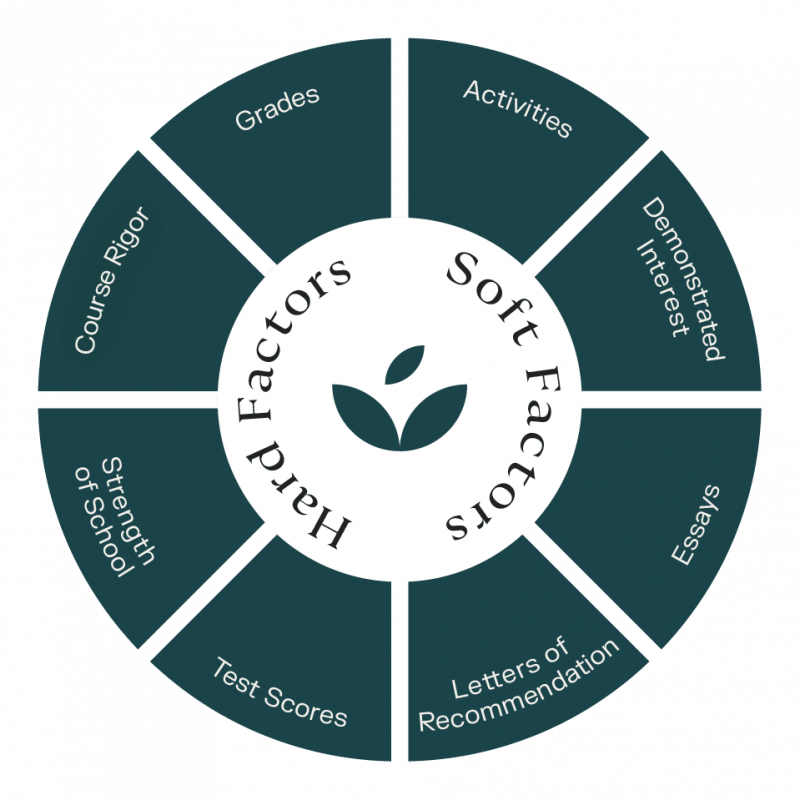
These are the key components of a holistic review, but other factors might be considered depending on the school’s admission policies including admission interviews, portfolios, and auditions.
In the holistic review, colleges typically prioritize academics. The soft factors, especially extracurricular activities and personal statements, are critical differentiators because they provide insight into your character, passions, and potential contributions to the campus community — the impact of essays cannot be overstated. Recommendation letters can provide an outside perspective, and interviews allow you to provide more information about yourself beyond what’s included in your application.
The Impact of Diversity in Holistic Admissions
Colleges typically desire an inclusive and dynamic community; therefore, diversity is an important factor in the holistic admissions process because it enriches the educational environment. Admissions committees consider diversity not only in terms of race or ethnicity but also in socioeconomic background, geography, life experiences, perspectives, and talents. A diverse student body enhances classroom discussions, promotes cultural understanding, and prepares students to thrive in a global society.
For colleges, diversity contributes to a richer academic and social experience, encouraging students to engage with ideas and people different from themselves. This develops empathy, critical thinking, and collaboration, which are skills essential for success beyond college. By valuing diversity in admissions, colleges enroll students who not only excel academically but also bring varied voices and experiences that strengthen the campus community.
You can showcase your unique backgrounds and experiences through your admissions essays, where you reflect on formative moments, challenges you overcame, or cultural influences that shaped your identity. Additionally, involvement in community service, leadership in cultural organizations, or advocacy work can highlight your commitment to diversity and inclusion.
Navigating Test-Optional Policies in Holistic Review
Many colleges and universities have reinstated standardized testing requirements, but you can still find many schools with test-optional policies. Some believe these policies promote equity in admissions, reducing barriers for students from diverse backgrounds and encouraging a more inclusive admissions committee review process. Without mandatory test scores, admissions committees place greater emphasis on other components of the application.
So, should students submit their test scores under test-optional policies? It depends. Students should consider submitting scores if:
- Their scores fall within or above the middle 50% range for their target schools.
- They are applying to competitive programs (e.g., STEM or honors colleges) where scores may strengthen their academic profile.
- Their educational background (e.g., homeschooling or non-traditional grading) benefits from additional academic validation.
Conversely, students may choose not to submit scores if:
- Their scores are below average and do not reflect their true academic potential.
- They experienced barriers to testing, such as illness or limited access.
Understanding test-optional policies helps you determine if submitting test scores to a particular school is in your best interest. Check the testing policies of each school on your list — some institutions, including those in the University of California system, do not accept test scores at all!
Preparing for Holistic Admissions: Essays and Interviews
The whole point of the holistic admissions process is for the admissions committee to understand your character, values, and aspirations. Your essays, more than anything else on your application, help admissions officers get to know the real you. Admissions interviews are another way, though not all colleges use interviews in their admissions process.
Writing Impactful Essays
Admissions committees review college applications hoping to see authenticity, reflection, and a compelling narrative, so it’s important to be yourself in your essays and not who you think they want you to be. Strong essays often demonstrate self-awareness, passion, and a clear sense of purpose, helping admissions officers envision your potential contributions to campus life.
Whether you’re using the Common App or the Coalition Application, you will be required to write a personal statement. This essay is submitted to every school you apply to within those application platforms. The supplemental essays are school-specific and provide you with an opportunity to include specific details about what you’re looking forward to exploring on campus (certain classes, professors, clubs, etc.), and how you plan to make an impact in the community. This is your chance to demonstrate your interest in attending, so make the most of it.
Acing the Admissions Interview
The admissions interview process can be evaluative or informational — if it’s evaluative, that means it’s part of your application review, while informational interviews are mostly an opportunity for you to learn more about the school. In many cases, these interviews are optional, but we always recommend that you take advantage of them if they are offered. Many schools use alumni volunteers to conduct interviews, though you may also be interviewed by a member of the admissions team.
An evaluative interview serves several purposes:
- It offers admissions officers more insight into who you are beyond your application.
- It gives you an opportunity to demonstrate your interest in the school.
- It helps admissions officers gauge your emotional intelligence and maturity.
- It allows you to explain how your goals align with what the school offers.
There are many proven strategies to help you prepare for college interviews, including practicing your responses to common interview questions and preparing your own questions to ask the interviewer. It’s also important to present yourself professionally and arrive on time or slightly early to your interview. If it’s virtual, choose a quiet, well-lit space and test your tech setup before the interview begins. Don’t forget to send a thank you email or note after the interview!
Financial Aid Considerations in the College Application Process
In a holistic admissions process, financial aid considerations can play a nuanced role. While many colleges practice need-blind admissions, others may factor in a student’s financial need when making decisions.
Types of Financial Aid
You can access several forms of financial aid, including:
- Need-based aid, such as federal grants, state aid, and institutional scholarships, which are awarded based on financial circumstances.
- Merit-based aid, which rewards academic achievement, leadership, or special talents.
- Work-study programs, offering part-time campus jobs to help cover expenses.
- Loans, which must be repaid after graduation.
Navigating financial aid typically includes completing the FAFSA (Free Application for Federal Student Aid) and, in some cases, the CSS Profile for institutional aid. Deadlines and requirements vary by school, so early research is key.
The Importance of Understanding Financial Aid Options
Understanding your financial aid options helps with your college selection — you can target schools that offer generous aid packages and/or where you are likely to receive merit scholarships. Additionally, you can weigh the long-term financial impact of attending different colleges in case you need to take out student loans. Ideally, you will want to receive as much aid as possible that does not require repayment.
Holistic Review Benefits: A Comprehensive Overview
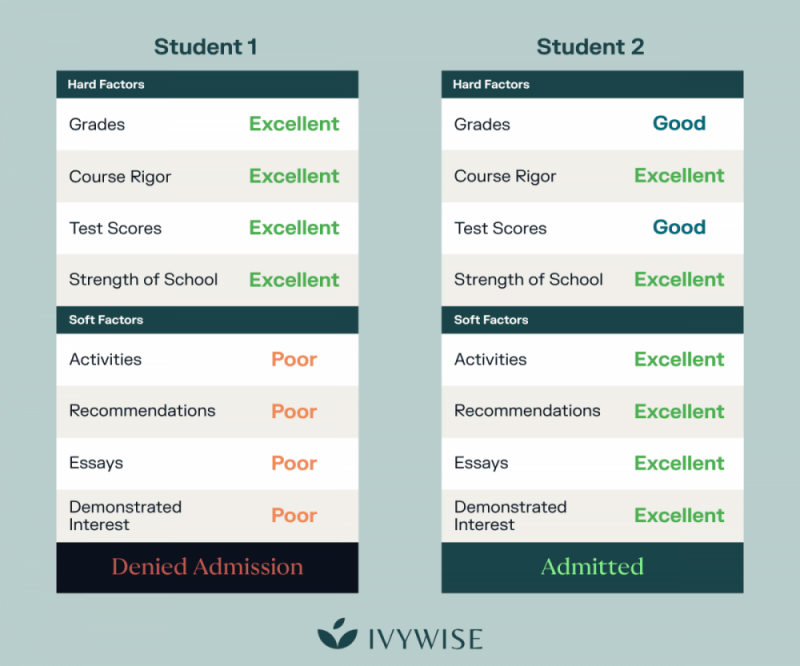
Holistic review benefits college applicants by recognizing their full range of experiences, talents, and personal growth. It gives you multiple pathways to stand out by showcasing your strengths beyond academics, which can help ease the pressure of earning the highest grades and test scores. This graphic demonstrates how a student with a good GPA and test scores and strong soft factors compares to a student with strong overall hard factors and poor soft factors.
An Inclusive Admissions Process
Because holistic review considers each applicant’s background and the opportunities available to them, it is an equitable and inclusive process that ensures students from diverse socioeconomic, geographic, and cultural backgrounds are considered fairly. Colleges assess achievements relative to circumstances, which helps level the playing field for students who may have faced challenges or had limited access to resources.
Colleges prefer to review applications holistically because it helps them build dynamic, well-rounded student bodies. This method supports the creation of diverse campus communities where students bring varied perspectives, talents, and life experiences. A more diverse campus helps students develop empathy, collaboration, and global readiness — qualities that are essential for success after college.
Develop Your Holistic Profile with IvyWise
Understanding how holistic review works ensures that you can focus on building a profile that’s authentic to your goals and interests — not shaping yourself into what you think colleges want. You don’t have to be a perfect student, but you do have to stand out in ways that are compelling and true to who you are. Additionally, preparing for holistic review helps you reflect on what you want from a college experience, which leads to better alignment between your goals and the schools you apply to.
At IvyWise, we help students develop their profiles and identify the colleges that are the best fit for them academically, socially, and financially. All our admissions counselors have extensive experience in admissions committees at some of the top schools in the country and are experts in holistic review. No matter where you are in the college prep process, we can help you maximize your chances of admission to your best-fit schools.
Learn More