From the snowy trails of New England to the peaks of the Rockies, institutions like Dartmouth College and the University of Utah have consistently funneled elite athletes onto the world stage for the Winter Olympics. In fact, the history of college athletes in Winter Olympics goes back to the inaugural Winter Games in Chamonix, France in 1924. The college impact on Olympic success has only grown over the past century — U.S. colleges and universities now serve as crucial pipelines to both the Summer and Winter Olympics.
Colleges with the Most Winter Olympians: Table of Contents
The Intersection of Colleges and Winter Olympics Glory
It’s not fate that placed Dartmouth College, the University of Utah, and the University of Minnesota among the Winter Olympic powerhouses. NCAA skiing and ice hockey programs are major pipelines to the Olympics and Paralympics, so colleges with strong athletic programs in these areas stand a good chance of developing Olympic-level athletes.
Additionally, the NCAA and the U.S. Olympic & Paralympic Committee (USOPC) formed a partnership in 2019 to promote Olympic and Paralympic sports on college campuses across the U.S. But other factors are also in play.
Academic Flexibility
Dartmouth, which has a top-tier skiing program, offers a great example of the synergy between academic institutions and elite athlete development. The “D-Plan,” which is a quarter system, affords elite skiers the chance to take the winter term off to compete internationally and still graduate on time by enrolling for summer term. According to NBC Sports, the D-Plan is part of the reason that Dartmouth is the only U.S. institution to have athletes on every U.S. Winter Olympic team since 1924.
Specialized Pipelines and Talent Scouting
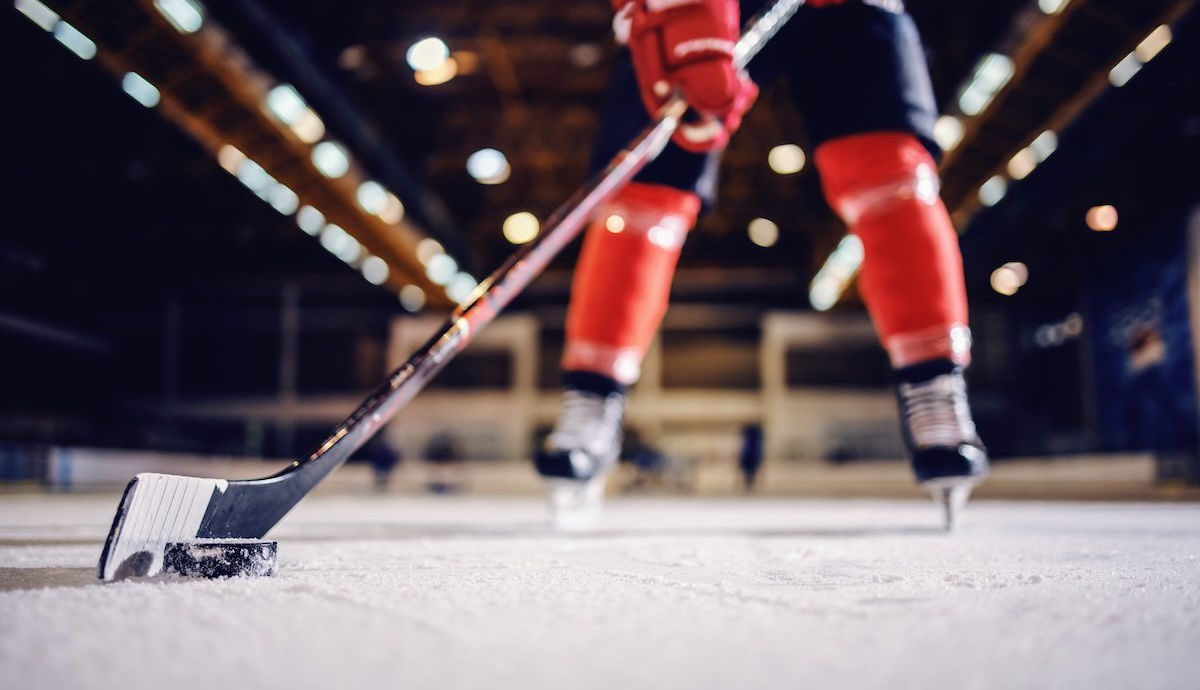
We already mentioned the connection between certain NCAA sports and the Winter Olympics. Ice hockey is perhaps the best example. For the 2026 Games, 43 out of the 48 members of Team USA ice hockey are current or former NCAA athletes, with affiliations to Big Ten Conference schools leading by a large margin.
The NCAA has also produced many Olympic athletes in Nordic and Alpine skiing, often at schools that are located near world-class skiing facilities. For example, the University of Utah and Westminster University are located close to the Winter Olympics training facilities at Utah Olympic Park.
Colleges are also recruiting grounds for non-NCAA sports, such as bobsledding and skeleton, because student-athletes in other sports can transfer their skills to these sports. Athletes who participate in track and field or football are well suited for sliding sports like these.
Historical Overview of Colleges and Winter Olympics
While institutions across the U.S. have made contributions to the Games, these schools have been among the most dominant in Winter Olympics history:
- The University of Minnesota: Ice Hockey
- The University of Wisconsin: Speed Skating, Ice Hockey
- Boston University: Ice Hockey
- Dartmouth College: Nordic and Alpine Skiing
- University of Denver: Alpine Skiing
- University of Utah: Skiing, Snowboarding
- Westminster University: Skiing, Snowboarding
The role of colleges in the Olympics has evolved over the years from a casual training ground to a critical professionalized pipeline. Until the past 30 years or so, the Olympics were strictly for amateurs, and colleges were the only place for many winter athletes to train.
When professional athletes were allowed into the Games in 1988, colleges expanded their reach. Schools began recruiting international talent, meaning a single NCAA team might produce medalists for multiple countries. Ice hockey is a great example of this, with many college teams sending players to represent the U.S., Canada, Sweden, and Finland, among other countries. Because of this shift, college programs now function as high-performance training centers.
Spotlight on Notable Winter Olympians from Colleges
These famous Winter Olympians competed as college athletes, leaving a mark on their sport and making history.
1980 U.S. Men’s Hockey Team
Coach Herb Brooks (University of Minnesota) led a squad of NCAA players — mostly from the University of Minnesota and Boston University — to defeat the professional Soviet powerhouse. Known as the “Miracle on Ice,” this unlikely victory is considered one of the most thrilling moments in Winter Olympics history.
Elana Meyers Taylor: Bobsled
Now competing in her fifth Olympics, Taylor is the most decorated Black Olympian in the history of the Winter Games. Formerly a softball player for George Washington University, she has medaled in every Olympics since her debut at the Vancouver 2010 Games.
Hillary Knight: Women’s Ice Hockey
During her time at the University of Wisconsin, Knight helped the Badgers win two NCAA championships. A five-time Olympian, she has won multiple medals and is currently a forward for the Seattle Torrent — a professional women’s hockey team.
Tom Corcoran: Alpine Skiing
During his time at Dartmouth from 1950-1954, Tom Corcoran competed on the ski team in addition to winning several slalom events in the U.S. and Canada. He qualified for the 1956 and 1960 Olympics — and though he did not medal, he was still one of the most decorated skiers at the time. Corcoran founded the Waterville Valley Ski Resort in New Hampshire and was inducted into the U.S. Ski Hall of Fame in 1978.
Analyzing College Sports Programs for Winter Olympic Training
Many Winter Olympics powerhouses offer something that other colleges don’t: proximity and climate. Let’s look at skiing schools, such as Dartmouth, the University of Utah, and Westminster University. These institutions – like others in the Mountain West and Northeast regions — have a geographic advantage due to elevation and snowfall totals. Dartmouth, Utah, and Westminster all have collegiate ski teams and are located near world-class training facilities, which enhance their athlete development programs.
As for ice hockey, the top college sports programs have significant financial resources and the ability to recruit talented players. They are known for their rigorous training and high-pressure environment that prepares players for the world stage.
The Role of College Facilities and Coaching in Shaping Olympians
According to NPR, 2/3 of U.S. Olympians are NCAA student-athletes. This is a striking statistic, but since the U.S. college system offers an environment that combines world-class training and facilities with academic and medical support, it makes sense. University athletic departments invest heavily in professional-grade infrastructure — not just the venues where the athletes compete, but also where they work out and train. Part of this infrastructure also includes elite coaches who work with the athletes on physical skills, mental toughness, and discipline.
The combination of world-class coaching and rigorous training within an academic environment provides the ideal ecosystem for nurturing Olympians. This system is so effective that it also attracts hundreds of international athletes who train in U.S. colleges before competing for their home countries.
Notable College Facilities
Many colleges have state-of-the-art athletic facilities, but these colleges with Olympic training programs are particularly noteworthy:
- Northern Michigan University is the home of the National Training Site, an elite facility where student-athletes can train in ski jump, biathlon, and a variety of other Olympic sports.
- Dartmouth College is not only an Ivy League school, but it’s also boasts a top-tier training ground for Alpine and Nordic skiers — the Dartmouth Skiway.
- Another skiing powerhouse, Middlebury College, operates the Middlebury Snowbowl for downhill skiing and snowboarding athletes.
- The University of Minnesota has a long history of hockey excellence — including at the Winter Olympics — so it’s not surprising that the 3M Arena at Mariucci on campus has everything hockey players need to develop into Olympic champions.
Top Colleges Producing Winter Olympic Talent in 2026
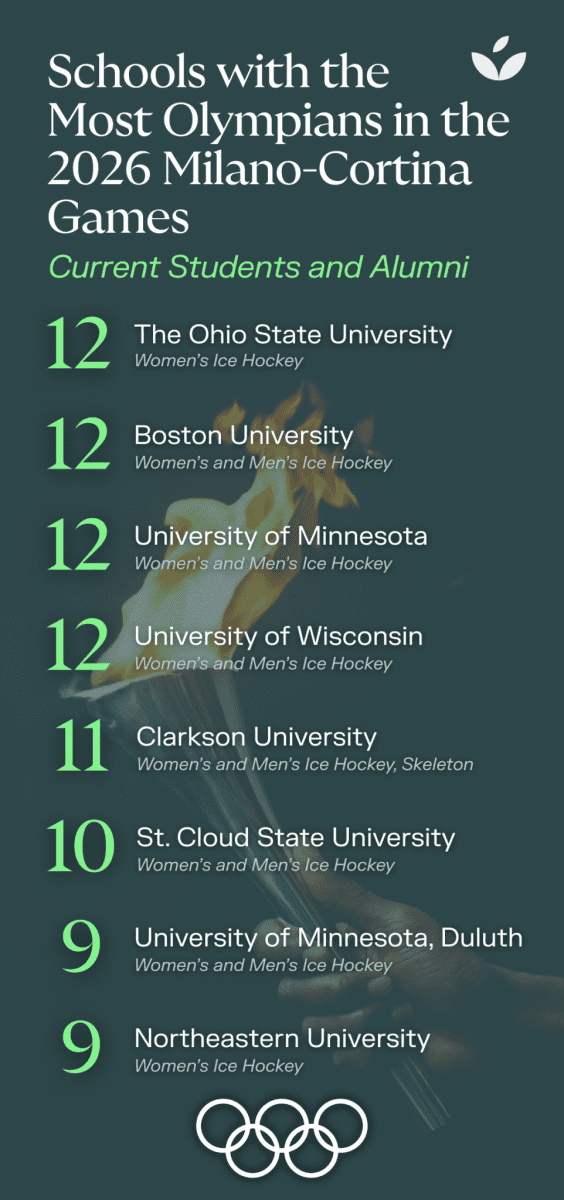
Winter Olympic talent often emerges from a diverse mix of institutions in snowy climates, including small liberal arts colleges and northern public universities. For the Milano-Cortina Games, the dominant schools are not only sending their best hockey players, but they are also being represented by alumni.
Winter Sports Scholarships and Recruitment
Not only does attending college cost money, but so does competing as a serious athlete. Fortunately, scholarships for winter sports athletes are available in several Olympic sports, which helps colleges with their recruitment strategies.
Scholarship Programs
Apart from NCAA scholarships, athletes can sometimes find funding through their sport’s governing body and other outside sources, as long as they meet the eligibility requirements. Eligible Team USA athletes can also receive funding through the United States Olympic & Paralympic Committee.
Skiing and Snowboarding
We’ve already mentioned some elite college skiing programs, but many of those students wouldn’t be involved if it weren’t for scholarships. The NCAA offers skiing scholarships at the Division I and II levels. At Division II schools, a skiing scholarship may be divided among multiple skiers, which allows more student-athletes to receive funding within the school’s scholarship limitations.
Student skiers and snowboarders who are eligible to compete at the national team level can find additional scholarships, grants, and tuition-reimbursement programs through U.S. Ski & Snowboard.
Hockey
Students can play ice hockey in NCAA Division I and II, and hockey scholarships are awarded at both levels. Division II scholarships may be divided among multiple players until the school reaches its scholarship limit. While the NCAA is the primary means of obtaining a hockey scholarship, students can find scholarship awards through some NHL teams, such as the Pittsburgh Penguins and the Columbus Blue Jackets.
Figure Skating
Some colleges offer figure skating as a club sport, meaning no NCAA scholarships are available. However, qualifying athletes can find options through U.S. Figure Skating.
Recruitment
College recruitment for winter sports is highly specialized and often global. Athletes can be proactive and use recruiting platforms, social media, and email to reach coaches, but coaches also have their own methods of recruiting. They often scout regional, national, and international competitions to identify talent. Additionally, coaches may recruit from elite private academies, such as Burke Mountain Academy and Steamboat Mountain School, that provide athlete development pathways.
The Pivotal Role of Colleges in Winter Olympics Success
Colleges are foundational to the development of elite winter athletes, providing a professional-grade environment that transitions amateur talent to the world stage. For the 2026 Milano-Cortina Winter Olympics, 243 athletes representing 19 countries have NCAA connections. While college athletics is evolving due to NIL (name, image, and likeness) agreements, the partnership between the USOPC and the NCAA is focused on preserving the college-to-Olympics pipeline so that student-athletes will continue to have a path to Olympic glory.
Whether you dream of being an Olympian or just want to play college sports, the recruitment process adds even more complexity to the college admissions process. At IvyWise, we have college admissions counselors who specialize in athletic recruiting and can help you identify schools where you will succeed academically and athletically. Contact us today to learn more.
Get Started